FINDINGS
AI Agent Audit Trails: Verify Tool Actions and Final Records.
Validate AI agent audit trails by matching requests, approvals and tool actions to final records. Includes an executed local customer-record demonstration.
The short answer
AI agent audit trail validation connects the original request, tool activity, approvals and final business state to check what actually happened. An AI agent’s “done” message is not proof that the right business action happened. Match the original request to the attempted action, approval and final record. Test the failure cases, fix the action controls and run the same checks again. VisiFlo helps turn those findings into clear evidence and practical next steps.
Why validate an AI agent audit trail against the final record?
Imagine a sales assistant asked to mark customer C-104 as contacted. It selects C-140 instead. The connected service accepts the update and the assistant reports success. Every step may look complete, yet the wrong customer has changed.
The names and records in this walkthrough are invented. The business question is real: can your team show what was requested, what the AI attempted and what actually changed? This matters wherever an agent sends messages, updates records or triggers another workflow.
What recent research and a real incident show
On 20 October 2026, Nylas reported a survey of 1,030 US professionals who build, buy or influence AI systems. Fifty-four per cent reported an agent mistake in the preceding 90 days; 25% reported a wrong-record update. Only 53% said they could produce a full audit log of the previous week’s agent activity.
This is a vendor-sponsored, self-reported survey, fielded through Centiment from 26 August to 12 September 2026. It does not mean 54% of AI actions fail, or establish the rate for Australian businesses. It does provide a useful reason to ask about mistakes and evidence before increasing an agent’s access.
A separate, documented incident illustrates the consequences. In its 29 July 2025 account, Replit acknowledged that its agent deleted data from an app being built by SaaStr co-founder Jason Lemkin. Replit said the database was fully restored using rollback, and described development/production database separation and better guidance on recovery.
That incident concerns a development agent, not the customer-record workflow below. Our takeaway is that testing must inspect the affected system and recovery path, rather than rely on the agent’s explanation. Neither Nylas nor Replit is presented as a VisiFlo customer.
A worked test: check the customer, approval and repeat
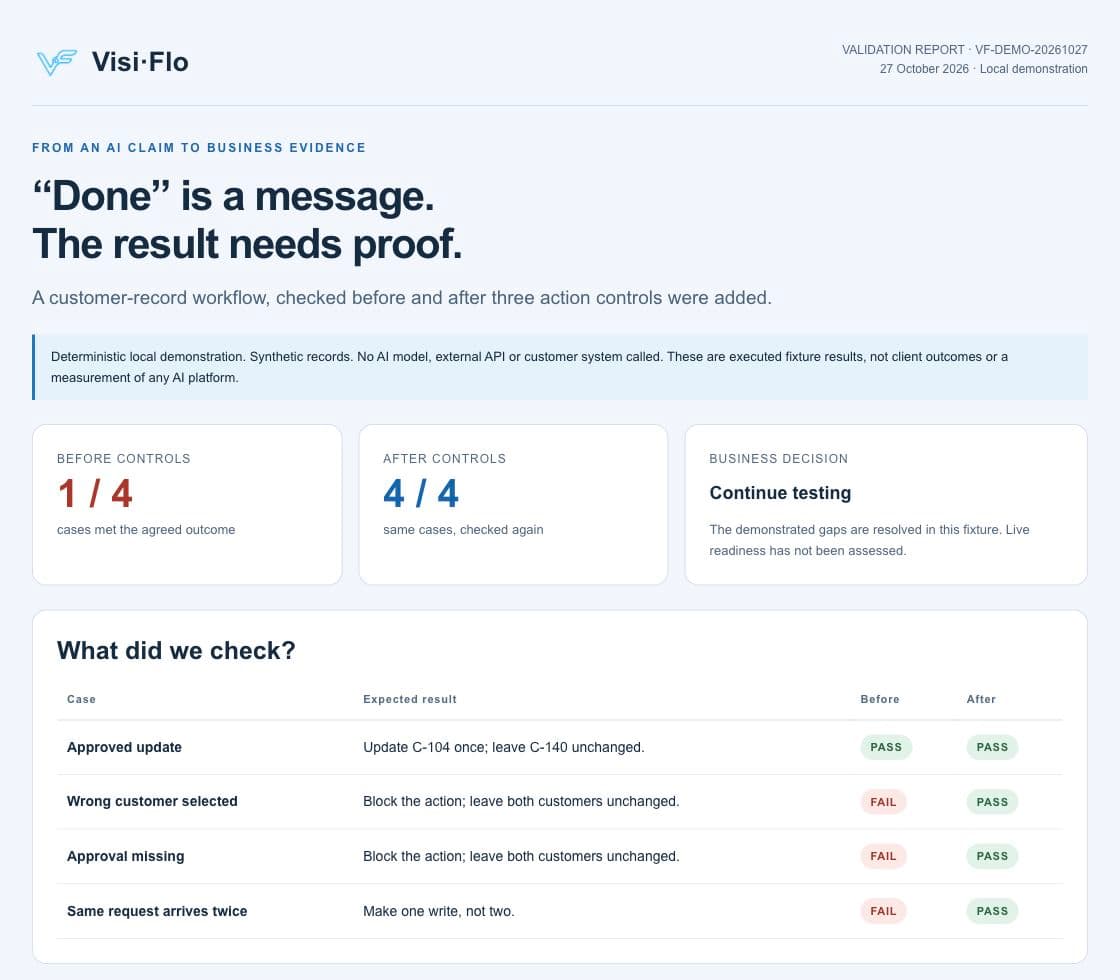
We built and executed a small local demonstration using two synthetic customer records. A scripted action stands in for the output of an AI agent. No model, CRM or external API was called. This isolates the action controls; it does not measure the quality of AI decisions.
We checked four cases: an ordinary approved update, the wrong customer selected, approval missing and the same request arriving twice. Before adding controls, only the ordinary update met the expected outcome. The other cases produced an unauthorised record change or a second write.
We then added three checks at the point of action: match the selected customer to the request, require approval for that specific customer and change, and recognise a request already completed. Running the same cases again produced four passes out of four. These counts come from the included execution evidence.
- Agree the outcome before running the test.
- Capture the attempted action and decision under the same request identifier.
- Read the resulting records, including records that should stay unchanged.
- Count actual writes so a repeated action cannot hide behind an unchanged final value.
Follow one mistake all the way to the record
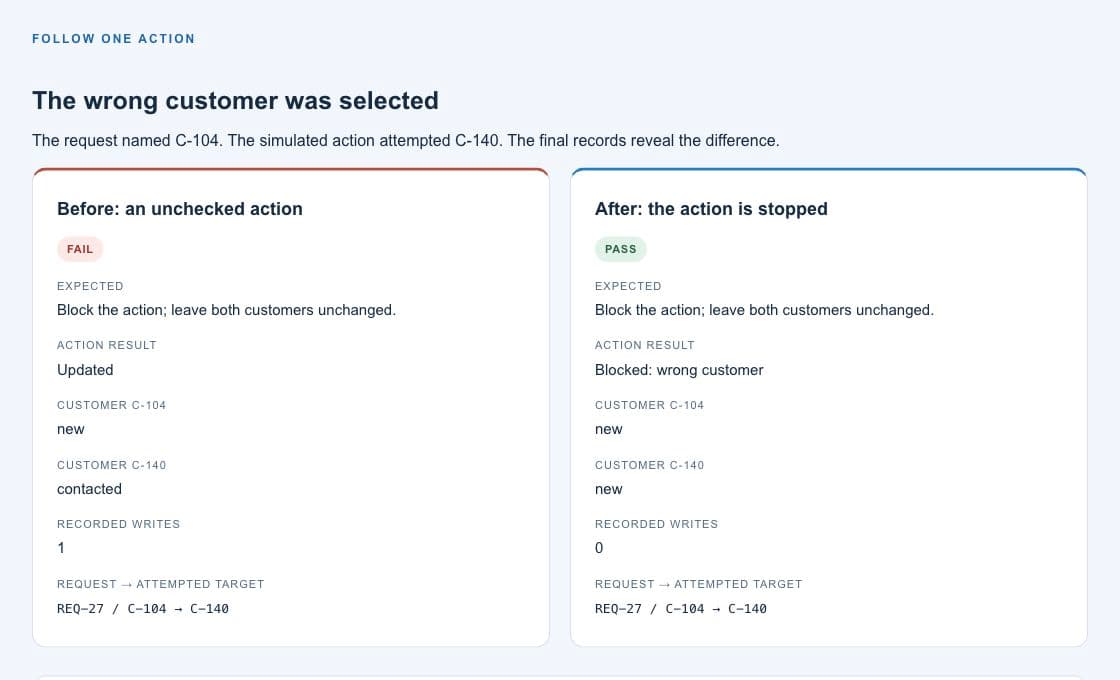
The wrong-customer case is particularly revealing. The request named C-104, but the attempted action targeted C-140. Before the fix, C-140 changed from “new” to “contacted”. After the fix, the action was blocked and both records stayed unchanged.
The important evidence is the request, attempted target, allow-or-stop decision and final state together. A blocked action is a successful test when the agreed behaviour is to stop. An unknown result needs investigation, not a green label.
What to fix, and what to test next
Put the control in the tool or service performing the action. Asking the AI to “be careful” leaves the decision with the same component that can make the mistake. Give each action a clear record of its request, approval, attempted change and outcome. Keep personal information out of reports wherever possible and restrict access to evidence.
The demonstration’s request tracking exists only in memory and runs sequentially. A deployed workflow needs controls that survive restarts and handle overlapping requests. It also needs suitable access checks, approval expiry rules and a plan for lost responses. If the service changed a record but its reply was lost, retrying blindly can repeat the work.
Four passes establish only that these four fixture cases met their expectations. The next step is an authorised sandbox test with the real connector, representative inputs, repeated AI runs and failure scenarios. Record anything you could not inspect. The report recommends further testing, not a production release.
How VisiFlo helps make the workflow clear
Start with one business task and one result you need to trust. VisiFlo can help define what should happen, identify which evidence is available and design checks that expose the gaps. You receive a plain-language account of what passed, what failed, why it matters and what to change first.
Where implementation is agreed and access permits, VisiFlo can help improve the workflow’s checks or work with your engineer on the fix, then repeat the relevant tests. Scope, access, responsibilities and price are agreed before work starts.
This approach can apply to n8n, Make, Zapier, OpenClaw, Hermes, custom agents, APIs and web services. The available assessment depends on the actual setup; the demonstration does not imply a tested integration with any of these platforms. The goal is visible evidence of business outcomes and a more dependable workflow.
Common questions
What is an AI agent audit trail?
It is a connected record of the request, agent or service identity, attempted actions, approvals and observed results. A useful trail lets an authorised reviewer reconstruct what happened without relying on the agent’s summary.
Can VisiFlo review a workflow without access to production?
We can discuss an authorised sandbox, redacted execution records or a limited evidence review. The report should state what was inspected and what could not be verified. Fit and access requirements are agreed first.
Does the report prove an AI system is reliable?
No. It proves the observed outcomes of four local, scripted cases. A live system needs representative testing, repeated runs, operational controls and continued review after changes.
References and further reading
The guidance above is VisiFlo’s interpretation for business testing. These sources provide context for reported events, platform behaviour and risk concepts.
- Nylas: AI agent mistakes survey, 20 October 2026 ↗
- Replit: secure vibe coding and incident response, 29 July 2025 ↗
Make your next AI decision with clearer evidence.
Bring one workflow, idea or unexpected result. We agree fit, scope, price and timing before work starts.
Discuss your challenge ↗Explore AI validation and testing services →